


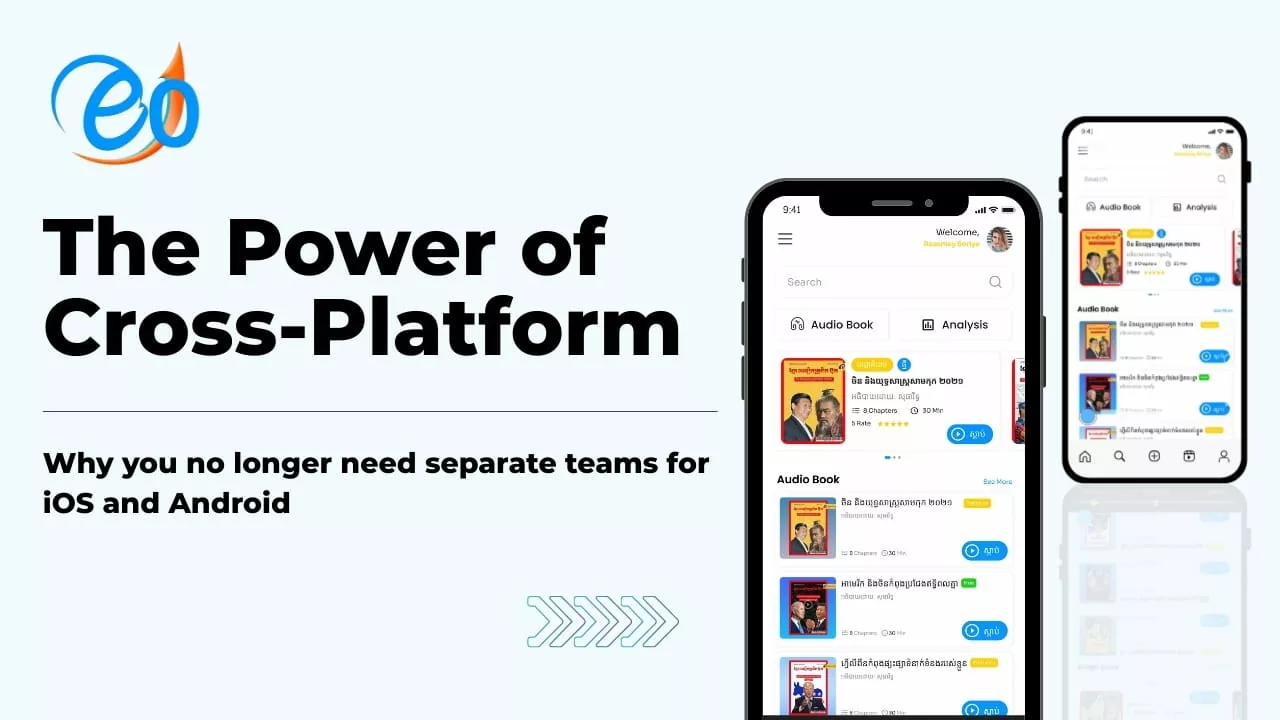
For years, the standard playbook for building a mobile app was set in stone: hire a Swift/Objective-C team for iOS and a Kotlin/Java team for Android. This “siloed” approach was born out of necessity, as early cross-platform tools often resulted in clunky interfaces and sluggish performance.
However, the tide has turned. The emergence of powerful frameworks like Flutter and React Native has rewritten the rules of mobile development. Today, maintaining two separate engineering teams isn’t just expensive—it’s often inefficient.
Here is why the shift to cross-platform is no longer a compromise, but a competitive advantage.
1. Unified Logic, Faster Time-to-Market
In the traditional model, every feature must be designed, developed, and tested twice. If you want to launch a new loyalty program, the iOS team and the Android team must build the same logic independently. This often leads to “feature lag,” where one platform receives updates weeks or months before the other.
Cross-platform development allows you to share up to 90% of your codebase. This means a single team can deploy features to both App Stores simultaneously, ensuring your entire user base enjoys a consistent experience at the same time.
2. Radical Cost Efficiency
Operating two separate teams means double the overhead. You aren’t just paying for more developers; you’re paying for double the project management, double the QA testing, and double the recruitment costs.
By pivoting to a cross-platform strategy, businesses can significantly reduce their burn rate. You can invest those saved resources back into marketing, user acquisition, or further product innovation.
3. Native-Grade Performance
The biggest argument against cross-platform used to be performance. “It doesn’t feel native,” was a common refrain. Modern frameworks have solved this. By compiling directly to native machine code or using highly optimized bridges, cross-platform apps now offer the smooth scrolling, haptic feedback, and lightning-fast transitions that users expect. Most users today cannot tell the difference between a high-quality cross-platform app and a native one.
4. Simplified Maintenance and Scalability
Bug fixing in a dual-team environment is a game of “whack-a-mole.” A security vulnerability found on iOS might also exist on Android, requiring two separate fixes. With cross-platform, one fix generally repairs the issue across the board. This streamlined maintenance ensures your app stays secure and up-to-date with half the effort.
Is It Time to Make the Switch?
For startups and enterprises alike, the goal is the same: build a high-quality product that reaches the maximum number of users with the minimum amount of friction. The technical barriers that once necessitated separate teams have vanished.
If you are looking for ways to streamline your digital transformation, we can help you navigate the transition. You can explore our solutions to see how we leverage modern technology to build world-class mobile experiences.
Conclusion
The “Native vs. Cross-Platform” debate is effectively over. For the vast majority of business applications, the efficiency, speed, and cost-effectiveness of cross-platform development far outweigh the benefits of maintaining separate teams. In 2024 and beyond, the power of a single, unified codebase is the smartest way to build for mobile.
Ready to build your next big project? Contact us today to learn how we can bring your vision to life on every platform.


